contact us over the viber.
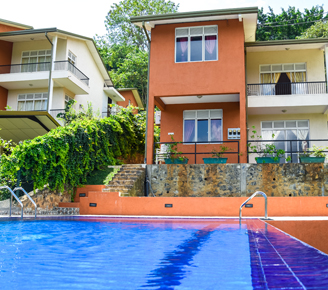
Historical records suggest that Kandy was first established by the King Wickramabahu (1357-1374 CE) near the Watapuluwa area, north of the present city, and it was named Senkadagalapura at the time, although some scholars suggest the name ‘Katubulu Nuwara’ may also have been used. The origin of the more popular name for the city, Senkadagala, could have been from a number of sources. These include naming it after a brahmin named Senkanda who lived in a cave near the city, after a queen of King Wickramabahu named Senkanda or after a coloured stone named Senkadagala.
In 1592 Kandy became the capital city of the last remaining independent kingdom in Sri Lanka after the coastal regions had been conquered by the Portuguese. Invasions by the Portuguese and the Dutch (16th, 17th and 18th century) and also by the British (most notably in 1803) were repelled. The last ruling dynasty of Kandy was the ‘Nayaks’ of Kandy while the Kingdom preserved its independence until it finally fell to the British in 1815. The British deposed the king, Sri Wikrama Rajasingha, and all claimants to the throne, thus ending the last traditional monarchy of Sri Lanka, and replacing it with their monarchy. As the capital, Kandy had become home to the relic of the tooth of the Buddha which symbolises a 4th-century tradition that used to be linked to royalty since the protector of the relic was seen fit to rule the land.
Thus, the Royal Palace and the Temple of the Tooth were associated with the administrative and religious functions of the capital city.
Even after its conquest by the British, Kandy has preserved its function as the religious capital of the Sinhalese and a place of pilgrimage for Buddhists, namely those belonging to the Theravada school.

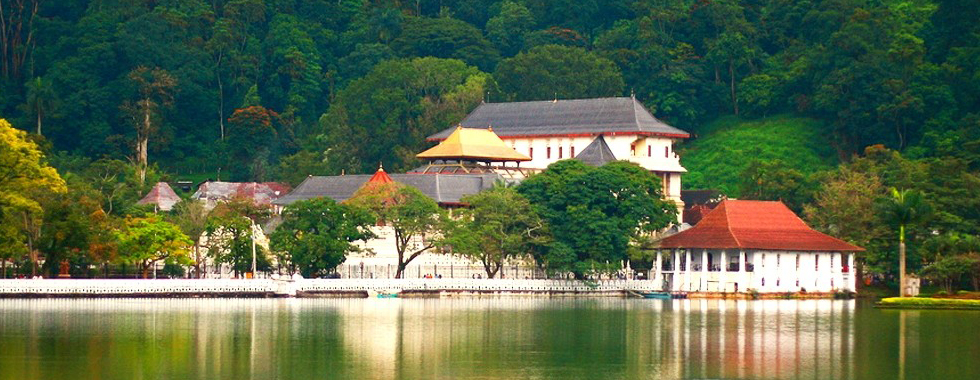
Sri Dalada Maligawa The Sri Dalada Maligawa or the Temple of the Sacred Tooth Relic is a temple in the city of Kandy in Sri Lanka. It was built within the royal palace complex which houses the only surviving relic of Buddha, a tooth, which is venerated by Buddhists. The relic has played an important role in the local politics since ancient times and it’s believed that whoever holds the relic holds the governance of the country, which caused the ancient kings to protect it with great effort. Kandy was the capital of the Sinhalese Kings from 1592 to 1815, fortified by the terrain of the mountains which was difficult to approach. The city is a world heritage site declared by UNESCO, partly due to the temple. Monks of the two chapters of Malwatte and Asgiriya conduct daily ritual worship in the inner chamber of the temple, in annual rotation. They conduct these services three times a day: at dawn, at noon and in the evening. On Wednesdays there is a symbolic bathing (Nanumura Mangallaya) of the Sacred Relic with a herbal preparation made from scented water and fragrant flowers.
Esala Perahera
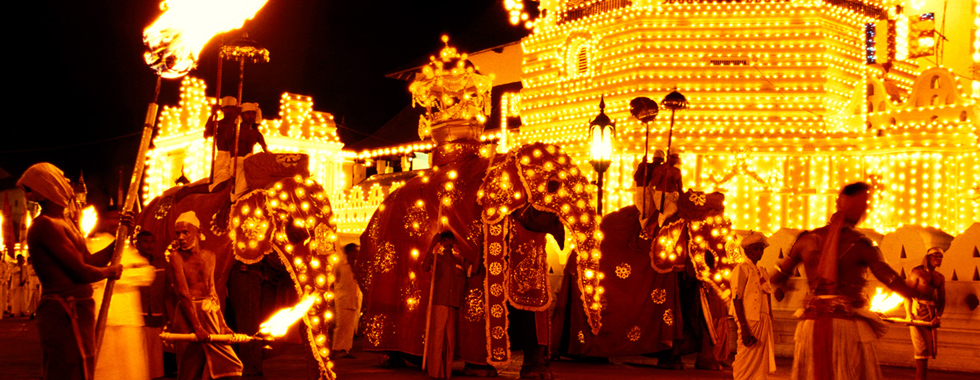
This holy water is believed to contain healing powers and is distributed among devotees who are present. The Esala Perahera in Kandy is one of the oldest and grandest of all Buddhist festivals, featuring dancers, jugglers, musicians, fire-breathers, throngs of devotees and lavishly decorated elephants This is in Esala (July or August), which is a month that is believed to commemorate the first teaching by Buddha after he attained enlightenment. The Kandy Esala Perahera lasts for ten days while the Sinhalese term ‘perahera’ means a parade of musicians, dancers, singers, acrobats and various other performers accompanied by a large number of caparisoned Tuskers and other elephants parading the streets in celebration of a religious event.
Ceremonies
The worship of corporeal remains of the Buddha, as recorded in the ‘Mahaparinibbana-sutta’ (the Record of the Demise of the Buddha), was sanctioned by Buddha himself on the verge of his passing away. The Buddha declared that four noble persons are worthy of their bodily remains being enshrined and honoured, the Buddha, the Personal Buddhas (Pacceka Buddhas,) the Arahanths (Buddha’s disciples) and the Universal Monarchs ( Cakkavatti kings). The bodily remains of the Buddha, after their distribution among various states that claimed the relics, were enshrined in the funerary mounds known as ‘stupa’. However, the four canine Teeth were said to have been separately enshrined and worshipped. The right canine was worshipped in the heavenly domain of the king of gods, Sakra, while another was worshipped by the king of Gandhara in modern Pakistan. The third was taken away by the Nagas and worshipped placing it in a golden shrine room.
The fourth, the left canine was removed from the funerary ashes by a monk and was handed over to the king of Kalinga in Eastern India, as recorded in the Digha Nikaya. Thenceforth, the Tooth relic of the Kalinga became an object of great veneration by generations of Kalinga kings until it earned the wrath of ‘brahmanical followers’, and consequently several attempts were made to destroy the Relic by the fanatical rulers. Yet, the Tooth relic was miraculously saved from such atrocities. For this reason, the kings of other states attempted to possess the Tooth relic for personal veneration. Thus, from the beginning itself, the Tooth relic came to be considered as an important symbol of veneration. The last Indian ruler to possess the Tooth relic was Guhasiva of Kalinga (c.4th century AD).
Arrival of the Sacred Tooth Relic in Sri Lanka
The final attempt made by a neighbouring state to make war with Guhasiva for the possession of the Tooth relic caused this venerated relic to leave the Indian shores. By this time, Buddhism was well rooted in Sri Lanka, and the island rulers maintained close relations with the Indian states that fostered Buddhism. Apparently, it was for this reason that the Kalinga ruler, in imminent danger of losing in battle, decided to send the Tooth relic to his friend, the Sri Lankan king.
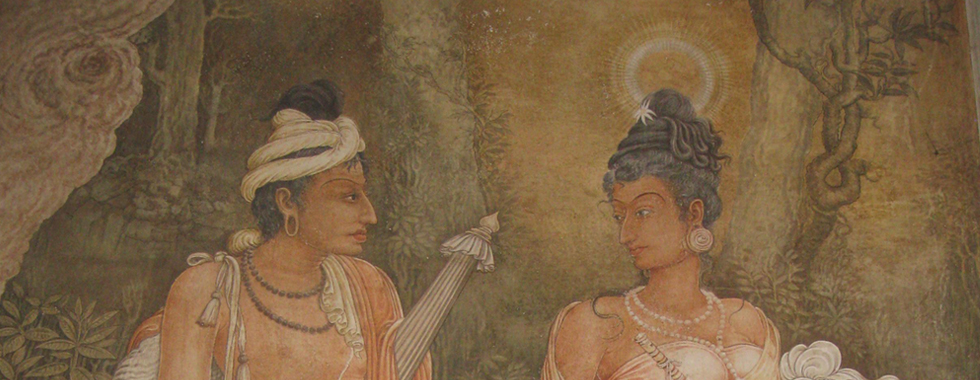
After about eight centuries of its Existence in India, the Tooth relic was secretly taken away by Danta and Hemamala, said to be the son-in-law and daughter of Guhasiva. The literary works like Dathavamsa, Daladasirita and the chronicle Mahavamsa, record many and varied vicissitudes that the couple went through en route to Sri Lanka in order to safeguard the relic. It is recorded that the prince and the princess donned the garb of ascetics and carried the Relic hidden within the coiffure of Hemamala not to be noticed by passersby. A twentieth century wall painting of the well known monastery of Kelaniya (about 5 miles east of Colombo), depicts this episode in a classic style executed by a local artist (Solius Mendis).
Danta and Hemamala were said to have embarked on a ship at the ancient port of Tamralipti, a busy port at the time, located at the mouth of the river Ganges, and reached the shores of Sri Lanka at the port of Lankapattana (modern Ilankeiturei) in the Trincomalee District. The Relic was reported to have performed several miracles en route on the ship itself, thus being venerated by human and superhuman beings. The Tooth Relic finally reached the Sri Lankan capital at that time, Anuradhapura, and according to the Sinhala text, Dalada Sirita, the Relic was kept at the Megagiri Vihara in the park Mahameghavana.
History of Sacred Tooth Relic in Sri Lanka
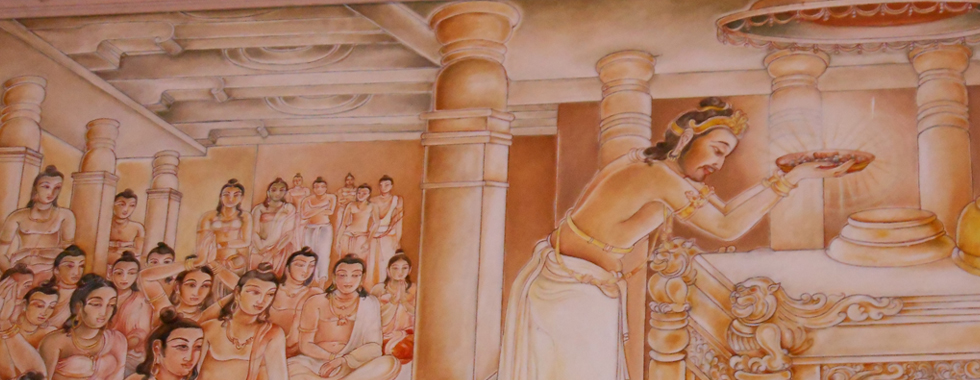
From the time of its arrival in Sri Lanka in the 4th century until the end of the 10th century when the capital Anuradhapura was shifted to Polonnaruwa, only a few instances are recorded in the chronicle Mahavamsa . Yet, Fa-Hsien, the Chinese traveller monk,who lived in the Abhayagiri monastery in the 5th century has left behind many details about the worship and rituals connected with the Tooth Relic. According to him, the procession instituted by King Kirti Sri Meghavanna in the 4th century, was continued in a grand scale. The sacred Tooth Relic was taken in procession from the Tooth Relic shrine to the Abhayagiri Vihara where the Relic was exhibited for three months with elaborate ritual worship.
Going by the descriptions of literary texts dealing with the sacred Tooth Relic, and also the sporadic references of the chronicle, it is possible to conclude that the sacred Tooth Relic was well guarded by the kings and considered it to be the palladium of kingship. Some of the kings even went to the extent of prefixing the term `Datha’ ( Tooth) to their names, e.g. Dathopatissa, Dathappabhuti, Dalamugalan, etc., which clearly indicates their close association with the sacred Tooth Relic.
The intrusion of South Indian Cholas and the internal disharmony in the ruling houses resulted in the Tooth Relic facing unsafe vicissitudes now and then. Yet, the historical records indicate that the Tooth Relic continued to be in the custody of the Anuradhapura rulers, until king Vijayabahu I shifted the capital to Polonnaruwa in the 11th century.
The present ruins of the Atadage at the Sacred Quadrangle (Dalada Maluva) in the ancient city of Polonnaruwa, is identical with the Tooth Relic temple built by king Vijayabahu. The Velaikkara stone inscription standing at the side of this edifice provides many details on the history of the Tooth Relic. It appears that the Tooth Relic, together with the Bowl Relic, was brought down from the Uttaramula -ayatana monastery of the Abhayagiri Vihara and installed in the Atadage shrine. This shrine, according to the Velaikkara inscription, was placed under the protection of the Velaikkara mercenaries who were in the service of the king.
Atadage
The Atadage was well known for the ritual known as the Netra-Mangallaya. The eye-balls of the Buddha image located in the ground floor shrine room were washed annually with unguents, as recorded in the inscription. The architectural plan of the Atadage, is significant mainly since the two-storied plan seems to have been the prototype followed in the later periods down to the present Dalada shrine at Kandy. According to the text Sasanavamsa, king Vijayabahu I maintained friendly relations with his contemporary, king Anuruddha of Burma even to the extent of the latter requesting the Sri Lankan ruler to send him the sacred Tooth Relic. The wise king appeased the Burmese king’s desire by sending him a replica of the Relic, which is said to be greatly venerated by the Burmese.The years following king Vijayabahu’s death appear to have been quite calamitous in the political field. The country came to be ruled under separate rulers who were weaklings. Consequently, many Buddhist shrines were destroyed. In this state of affairs, fearing the destruction of the sacred Tooth and the Bowl Relics, the monks secretly removed them to safer locations in the southern country, Rohana. With the accession of king Parakramabahu I in the year 1153 AD, the Sri Lankan political scene assumed a firm basis again. While rebuilding the country’s economy especially through vast agrarian schemes, he lost no time in bringing about a renaissance in the religious activities. Most of the existing religious edifices in Polonnaruwa remain mementos to his immeasurable service to the cause of Buddhism.
Parakramabahu I managed to secure the possession of the sacred Tooth Relic and the Bowl Relic and enshrined the sacred objects in a new edifice built in the centre of the city. He was also said to have the exposition of the Tooth Relic in a circular shrine built at the Jetavana monastery, which is possibly the ruined edifice in proximity to the Tivanka Patimaghara image house in the northern extremity of the ancient city.
The next great ruler to build a formidable Relic shrine for the accommodation of the sacred Tooth and Bowl Relics was Nissankamalla (1187-1196). As recorded in his inscriptions, he had the Relic Shrine Hatadage built and, having offered his son and daughter to the Relics, redeemed them with the completion of the shrine. This edifice lying almost adjoining the Atadage, represents a larger version of the Atadage.
By the beginning of the second quarter of the 13th century, the glory of Polonnaruwa waned, and with the invasion of Kalinga Magha, the capital was shifted to the south-western part of the country in the wet zone. Thus, began the Damabadeniya period, which saw the blossoming of an era of classical literary works.
By this time, the Tooth Relic and the Bowl Relic had again been taken away by the monks to a safer location in Kotmale in the central hills. Later, King Vijayabahu III was reported to have brought down the two Relics and enshrined them in a beautiful edifice built for the purpose on the hill top of Beligala. The king re-instituted the rituals connected with the Relics and handed over the custody of the Relics to his elder son, who succeeded to the throne under the name Parakramabahu II (1236-1270). Being an erudite scholar, he was well known for the compilation of classical literary texts, including the Kavusilumina.
Parakramabahu II brought down the Relics from Beligala in a procession with great veneration and placed them in a shrine built near the palace at the Damabadeniya rock According to the text Dalada Pujavaliya, Parakramabahu conducted the Relics to Srivardhanapura, the city of his birth, and held a great ritual worship. He was responsible for the building of the Tooth Relic shrine at the Vijayasundararama at Dambadeniya, where the Relic was deposited and festive rituals were conducted by the king.
The peaceful and prosperous time under Parakramabahu was disturbed by the invasion of Chandrabhanu of Java. However, the king was able to expel the enemy and bring back the country to a stable status again. It is recorded that during a severe drought, the sacred Tooth Relic was taken out of the shrine and a great procession held. He placed the Relic on the throne and having worshipped the Relic for seven days, offered the kingdom to the sacred Tooth Relic, which resulted in the termination of the drought. This incident indicates the esteem that the sacred Tooth Relic enjoyed as a symbol of kingship.
Even during the lifetime of Parakramabahu II, his son Vijayabahu as sub-king, renovated and enlarged the Relic shrine and conducted great ritual services. As the chronicle records, he restored the ruined religious edifices at Polonnaruwa, including the Tooth Relic shrine and having placed the Tooth Relic therein, conducted an abhiseka (coronation) ceremony.
Yapahuva (ancient Subha-pabbata) comes into prominence around this time with the appointment of his brother Bhuvanekabahu as the sub-ruler of this province. This location, simulating the well known Sigiriya rock fortress, found itself to be a very secure place for the Relics. However, Chadrabhanu of Java invaded the country for the second time and after defeating the local sub-ruler at Yapahuva, demanded the Tooth Relic from Vijayabahu of Dambadeniya. Yet, the Sri Lankan ruler was able to defeat him and bring peace to the island again. Bhuvanekabahu built a shrine for the sacred Tooth Relic at Yapahuva with a grand stairway the ruins of which still portray the aesthetic achievement of the 14th century. As the chronicle records, he continued the tradition of paying homage to the sacred Tooth Relic daily.
Almost after his reign, Sri Lanka again faced severe droughts and also an invasion from the Pandyan country in South India, under the great warrior Arya Cakravarti. He devastated the country and plundered much wealth and treasure, including the Tooth and Bowl Relics, which he handed over to the Pandyan king Kulasekera. The next king, ‘Parakramabahu III’ visited the Pandyan capital and after friendly discussions, brought back the Relics and initiated the traditional rituals. It is interesting to note that even at this late age, the Polonnaruwa Tooth Relic shrine was in existence, for the king is said to have brought the sacred Relics from India to Polonnaruwa and enshrined them at the old Tooth Relic shrine at the ancient capital, which was abandoned by this time. According to Marco Polo, the well known traveller, the Chinese Emperor, Kublai Khan, sent a messenger to obtain the Tooth, Hair and Bowl Relics from the king. However, the king was able to please the Chinese Emperor by dispatching two fake teeth, which were graciously received by the Emperor who established ritual worship for the objects. Bhuvanekabahu II (1293-1312) is reported to have brought the Tooth Relic from Polonnaruwa and placed it within a shrine built at his capital, Kurunegala.
Next ruler was Parakramabahu IV, during whose time, there was a religious revival. He reorganized the rituals connected with the sacred Tooth Relic in a systematic manner as recorded in the text Dalada Sirita. Yet another significant factor was the handing of the responsibility of the security and conduction of rituals in charge of the chief prelate of the Uttaramula monastery, an institution which originated from the Abhayagiri Vihara of Anuradhapura. The next ruler of note connected with the story of the Tooth Relic was Bhuvanekabahu IV, who selected a new capital, Gampola, in the central hills. Yet, no mention is made of his bringing the Tooth Relic to this new city. It was possibly Vikramabahu III who had the Relic shifted to this hill capital and held a festival in honour of the sacred Tooth Relic. He is credited with the building of the shrine at Niyangampaya at Gampola, which comes closer to the 14th century Gadaladeniya temple in the decorative elements.
Thereafter, Bhuvanekabahu V (1372-1408) shifted the capital to Jayavwardanapura Kotte closer to Colombo. Although he did not bring the Tooth Relic to the capital, he is reported to have conducted many ritual performances for the Relic. It was his successor, Virabahu, who brought down the Tooth Relic to Jayavwardanapura Kotte from Gampola. China entered into Sri Lankan politics during his reign. The Chinese general, Chen Ho, invaded the island, captured the king and the family and took them before the Chinese emperor at the time, together with the Tooth Relic. However, conflicting and stronger reports conclude that the Chinese general did not take away the Relic and that he left the island after paying due homage and worship to the sacred Tooth Relic. This belief is corroborated by subsequent reports on the processions, festivals and rituals conducted by rulers like Parakramabahu VI, who was held in high esteem as the greatest ruler of the late medieval period. He is said to have built a three-storied shrine for the Tooth Relic, had four golden caskets enveloping the sacred Tooth Relic and promulgated several regulations in the service of the Tooth Relic.
Sri Dalada Museum
The latest institution added to the Dalada Shrine is the ‘Sri Dalada Museum’. Ever since the Tooth Relic shrine was established in Kandy, different grades of visitors and devotees, ranging from Royalty and Heads of States to the poorest of the general public, have been offering various gifts to the Sacred Tooth Relic, and these were preciously protected in specially built store-rooms by the successive line of Diyawadana Nilames. On the initiative of the previous Diyawadana Nilame, Neranjan Wijeratne, it was decided that these valuable artefacts should be made available for public display. On the invitation of the Diyawadana Nilame, the Museum has now been beautifully designed and organized by Prof.Leelananda Prematilleke, the Archaeological Director of the UNESCO-Sri Lanka Project of the Cultural Triangle, together with his team of officers. The Dalada Museum is located on the first and the second floors of the new wing called the Alut Maligawa set up by one of the past Diyawadana Nilemes, T.B.Nugawela.
Victoria Golf & Country Resort
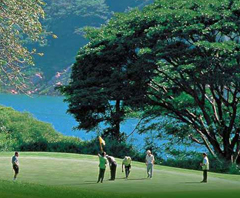
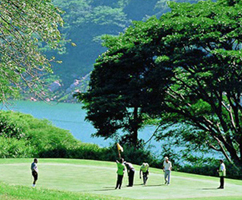
Which offers a feast for the senses. Wander down fairways lined by majestic Mara Rain Trees, just as two or three white egrets swoop across the landscape; absorb the fragrance of magnificently flowering shrubs, take an evening swim in our infinity pool with unparalleled views of mountains and flowing landscapes or play a set or two of tennis. Then there is dinner on the Terrace as the sun sets behind the magnificent Knuckles Mountain Range.
Pinnawala Elephant Orphanage
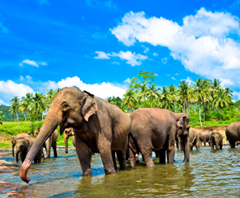
Pinnawala Elephant Orphanage is an orphanage, nursery and captive breeding ground for wild Asian elephants located at Pinnawala village, 13 km (8.1 mi) northeast of Kegalle town in Sabaragamuwa Province of Sri Lanka. Pinnawala is notable for having the largest herd of captive elephants in the world. In 2011, there were 88 elephants, including 37 males and 51 females from 3 generations, living in Pinnawala. The orphanage was originally founded in order to afford care and protection of wild elephants.
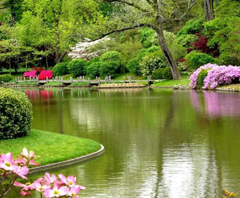
Royal Botanical Garden, Peradeniya is situated about 5.5 km to the west from the city of Kandy in the Central Province of Sri Lanka. and attracts 2 million visitors annually.It is near to Mahaveli river which is the longest river in Sri Lanka.It is renowned for its collection of a variety of orchids. It includes more than 4000 species of plants, including of orchids, spices, medicinal plants and palm trees. Attached to it is the National Herbarium of Sri Lanka. The total area of the botanical garden is 147 acres (0.59 km2).